


Folding hand fans may look simple at first glance, but a well-made fan is the result of careful design, material selection, and testing. Every time you flick one open, close it, tuck it into a bag, or use it outdoors on a warm day, the fan experiences small amounts of stress. One use will not usually reveal much, but repeated use quickly separates a strong folding fan from a weak one. That is why durability testing matters so much, especially for customers who want a fan that feels beautiful, opens smoothly, and lasts beyond one event or one summer afternoon.
When people shop for folding hand fans, they often focus on color, pattern, size, or style. Those things absolutely matter because a fan is also a fashion accessory, a wedding favor, a dance prop, a cultural item, and a practical cooling tool. Still, beauty alone is not enough. A fan that looks lovely but snaps at the rib, loosens at the pivot, or tears along the leaf after a few uses can turn from charming to frustrating very quickly. Good durability testing helps make sure the fan performs as well as it looks.
In this blog post, we will walk through how folding hand fans are tested for durability, from the first visual inspection to cycle testing, pivot stress checks, drop testing, humidity exposure, and final quality review. Whether you are buying fans for personal use, a wedding, a brand event, a dance group, or a gift shop, knowing how fans are tested can help you choose better. And when you are ready to browse practical, stylish, and gift-ready options, you can explore the full collection at Get My Fan.
Why Durability Testing Matters for Folding Hand Fans
Durability testing matters because a folding hand fan is made to move. Unlike a decorative wall piece that simply sits still, a fan is constantly opened, closed, gripped, waved, packed, carried, and sometimes dropped. That repeated movement puts pressure on the ribs, guards, pivot, rivet, and fan leaf. Even if a fan looks perfect when it is new, small weaknesses can show up after normal use, especially around the joints and folds.
Think of a folding hand fan like a tiny mechanical bridge. The ribs act like beams, the rivet acts like the central hinge, and the leaf acts like the flexible surface that connects everything together. If one part fails, the whole experience changes. A loose pivot can make the fan feel floppy. A cracked rib can make the fan open unevenly. A weak leaf can tear at the crease. Testing helps catch these problems before the fan reaches the customer.
Durability is especially important when fans are used for events. At weddings, outdoor parties, festivals, religious gatherings, performances, and corporate events, fans are often handled by many people in a short period of time. Guests may open them quickly, pass them around, place them on chairs, or carry them in purses and pockets. A fan that has been tested well is more likely to survive real-world handling without losing its shape, comfort, or charm.
For shop owners and bulk buyers, durability testing also protects reputation. Nobody wants to order dozens or hundreds of fans and discover that the quality is uneven. A reliable testing process helps create consistency from one fan to the next. That consistency builds trust, and trust is what makes customers return. When a folding fan feels solid in the hand, moves smoothly, and still looks good after repeated use, it quietly tells the customer, “This was made with care.”
What “Durable” Really Means in a Folding Hand Fan
The word durable gets used a lot, but with folding hand fans it has a very specific meaning. A durable fan is not just one that refuses to break. It is one that continues to open smoothly, close neatly, hold its shape, protect its design, and feel comfortable after repeated use. It should not become loose, warped, rough, sticky, or uneven too quickly. In other words, durability is about performance, appearance, and comfort working together.
A folding fan is made from several parts, and each part has its own job. The ribs provide structure. The guards protect the outer edges. The pivot allows movement. The rivet or pin holds the fan together. The leaf, whether made from paper, fabric, lace, or another material, creates the surface that moves air. Durability testing looks at how all these parts behave individually and as a complete product. A fan can only be considered truly durable when the whole system works well.
Some fans are built for occasional decorative use, while others are made for frequent handling. A wedding guest may use a fan for a few hours, while a dancer may open and close one many times during practice and performance. A collector may care most about finish and preservation, while a traveler may care about portability and strength. Testing standards can vary depending on the fan’s purpose, but the central question stays the same: can this fan handle the kind of life it is designed for?
Good durability does not mean a fan must feel heavy or stiff. In fact, a high-quality folding hand fan often feels light, balanced, and graceful. The best fans are strong without feeling clunky. They move with a pleasing rhythm, almost like a well-tuned musical instrument. That balance is what testing tries to confirm. A fan should feel easy in the hand, but it should not feel fragile.
Frame Strength
The frame is the backbone of a folding hand fan. It includes the ribs that spread across the fan leaf and the outer guards that protect the folded edges when the fan is closed. During durability testing, the frame is checked for cracking, splitting, bending, and uneven spacing. Materials like bamboo, wood, plastic, and metal each behave differently, so testers look for issues specific to the material being used.
For bamboo and wooden fans, testers often check whether the ribs have weak grain lines or tiny splits that could grow larger with use. Natural materials are beautiful because each piece has character, but they also need careful selection. A rib that is too thin may bend too easily. A rib that is too brittle may snap under pressure. A well-made frame should flex slightly when needed, but it should return to shape without damage.
For plastic or synthetic frames, testers may look for stress whitening, warping, and weak molded areas. These signs can suggest that the frame may not hold up well under repeated opening and closing. Metal frames, although less common in traditional folding fans, may be tested for bending resistance and corrosion concerns. Every material has strengths and tradeoffs, which is why testing is not one-size-fits-all.
Frame strength also affects how the fan feels. A strong frame gives the fan a confident snap when opened and a neat stack when closed. If the ribs are uneven or weak, the fan may wobble, drag, or spread awkwardly. That may seem like a small detail, but anyone who uses a fan regularly can feel the difference right away. A durable frame makes the fan more enjoyable to use.
Rib Flexibility
Rib flexibility is just as important as rib strength. If the ribs are too stiff, they may resist smooth movement and create pressure on the fan leaf. If they are too flexible, the fan may feel flimsy and fail to hold its open shape. Durability testing looks for that sweet spot where the ribs can move naturally without losing control. It is a bit like testing the flexibility of a fishing rod: too rigid and it can snap, too soft and it cannot do its job.
During flexibility checks, a tester may open the fan slowly, open it quickly, and gently press against the open arc to see how the ribs respond. The goal is not to abuse the fan, but to imitate normal handling and slightly rougher everyday use. A good folding hand fan should tolerate small twists, pressure from the hand, and repeated motion without cracking or becoming misaligned. If the ribs start to separate from the leaf or shift at the base, that is a warning sign.
Flexibility also affects airflow. A fan with ribs that hold their shape can move air more efficiently because the leaf remains spread in a consistent curve. If the ribs collapse inward or flutter too much, the fan may feel weaker even when waved quickly. This is why durability and function are closely connected. A fan that stays structurally sound usually performs better as a cooling tool.
Many customers never think about rib flexibility until something goes wrong. But once you have used a fan that opens evenly and stays balanced, it is hard to go back to one that feels loose or unreliable. Testing helps ensure that the fan does not just survive movement but actually feels pleasant during movement. That is the hidden craft behind a fan that seems effortlessly elegant.
Fabric, Paper, or Leaf Quality
The fan leaf is the broad surface attached to the ribs, and it plays a major role in durability. Depending on the design, the leaf may be made from paper, silk, cotton, lace, synthetic fabric, or a blended material. Each type of leaf has its own testing needs. Paper fans may be checked for tear resistance and crease strength. Fabric fans may be checked for fraying, stretching, and adhesion. Decorative fans may also be checked for print stability, embroidery quality, or painted detail.
One of the most common weak points is the fold line. Folding hand fans depend on repeated creasing, and every crease becomes a stress point. A low-quality leaf may begin to split along those lines, especially after many opening and closing cycles. Testers inspect whether the material can bend repeatedly without tearing or becoming fuzzy at the edges. The leaf should fold neatly back into place instead of bunching, wrinkling, or pulling away from the ribs.
Adhesion is another key concern. The leaf must stay firmly attached to the ribs without glue marks, lifting edges, or stiff patches that interfere with folding. When the fan opens, the leaf should spread evenly. When it closes, the folds should stack smoothly. If adhesive fails, even a strong frame cannot save the fan’s performance. This is why testing often includes close inspection of the glue lines and attachment points.
Leaf quality also affects appearance over time. A fan may be used at sunny outdoor events, humid venues, or crowded celebrations where it brushes against clothing and bags. A durable leaf keeps its design readable and attractive under realistic conditions. Whether the fan is minimal, floral, artistic, cultural, or branded, the surface should hold up well enough to keep the fan looking presentable. A beautiful design deserves a structure that protects it.
Pre-Test Inspection Before Any Fan Is Used
Before a folding hand fan is put through active durability testing, it usually goes through a careful pre-test inspection. This first step is simple but extremely important. Testers examine the fan as it arrives, looking for visible flaws, inconsistent construction, and signs of damage from production or packaging. If a fan already has cracks, loose glue, stains, or uneven folds before testing begins, those issues need to be recorded.
A pre-test inspection gives testers a baseline. Without it, it would be difficult to know whether a crack happened during cycle testing or was already present. This is similar to checking a rental car before driving away. You look at the condition first so that later changes can be judged fairly. With fans, the same idea applies. The initial condition tells testers what they are starting with.
During this stage, the fan is opened and closed gently. The tester listens and feels for rough movement, scraping, popping, or stiffness. A little resistance may be normal in some materials, especially when a fan is new, but serious unevenness can suggest a construction problem. The tester also looks at whether the fan opens to the intended arc and whether it closes into a neat stack. These details reveal a lot about craftsmanship.
Pre-test inspection is not only about finding failures. It also helps identify what makes a fan well built. Smooth edges, even rib spacing, clean attachment points, clear decoration, and balanced weight all point toward thoughtful manufacturing. When a fan passes this first stage with confidence, it is ready for more demanding tests. When it does not, the issue can be addressed before customers ever see it.
Material Identification
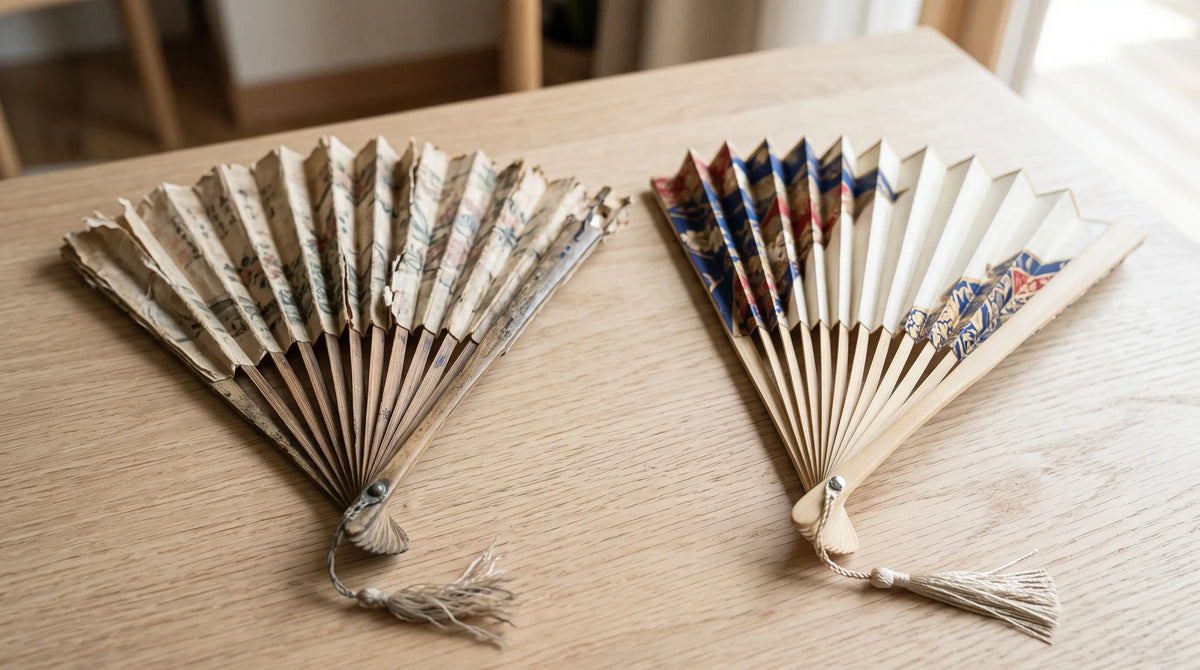
Material identification helps testers understand how a fan should behave. A bamboo fan, for example, should not be judged exactly like a plastic fan. Bamboo may have natural grain, slight color variation, and a warm hand feel. Plastic may have more uniform color and shape, but it may react differently to heat or repeated bending. Fabric, paper, and lace leaves also require different inspection methods.
Identifying materials also helps predict possible failure points. Natural wood can split if it is too dry or poorly cut. Paper can tear if the fibers are weak or the fold lines are stressed too heavily. Fabric can fray if edges are not sealed or finished well. Printed surfaces can scuff if the ink or coating is not properly bonded. When testers know the material, they know where to look.
This step can also confirm whether the fan matches product expectations. If a fan is marketed as having a fabric leaf, it should not feel like thin paper unless that is part of the design. If a frame is described as bamboo or wood, it should have the appropriate structure and finish. Accurate materials matter for customer trust, especially when people are buying online and cannot touch the fan before purchase.
For buyers, material awareness is useful too. A delicate lace fan may be perfect for a bridal look or photo shoot, while a sturdy bamboo and fabric fan may be better for regular summer use. Neither is automatically better in every situation. The right fan depends on the purpose. Durability testing helps confirm that each material performs well for its intended role.
Measurements and Tolerance Checks
Measurements may sound boring, but they are a big part of fan quality. A folding hand fan relies on symmetry. The ribs must be spaced correctly, the leaf must be aligned, the pivot must sit in the right position, and the outer guards must close evenly. If measurements are off, the fan may still open, but it may not open beautifully. Over time, those small differences can create stress and wear.
Tolerance checks look at acceptable variation. Handmade or semi-handmade fans may have tiny differences from one piece to another, and that can be part of their charm. But there is a limit. If one rib is noticeably shorter, thicker, or misaligned, the fan may pull unevenly when opened. If the rivet hole is not centered, the fan may feel loose on one side and tight on the other. Testing helps separate natural variation from true defect.
The width of the closed fan also matters. A properly made fan should fold into a compact shape without forcing the leaf or crushing the ribs. If the folds are too bulky or uneven, customers may struggle to close the fan neatly. That frustration can shorten the fan’s life because people may press harder or twist the fan to make it close. Good measurements prevent that problem.
Tolerance checks also support consistency in bulk orders. When customers order fans for weddings, parties, or retail displays, they usually expect the items to look similar. A set of fans with wildly different sizes or shapes can look careless. Careful measuring helps maintain a polished presentation. It is one of those quiet details that most people only notice when it is missing.
Opening and Closing Cycle Testing
Opening and closing cycle testing is one of the most important ways to test a folding hand fan. Since the fan’s main action is repeated movement, testers need to know how well it handles that movement over time. The process usually involves opening and closing the fan many times while monitoring the frame, leaf, pivot, and fold behavior. This test is practical because it mirrors real life better than a simple one-time inspection.
A fan can look excellent when it is new, but repeated motion reveals hidden weaknesses. Glue may start to lift. A rib may loosen. The pivot may become wobbly. The leaf may begin to wrinkle or tear along the fold lines. Cycle testing creates a controlled way to find these issues before the customer does. It is like walking a pair of shoes around the room before deciding whether they are comfortable enough for a full day.
The number of cycles may vary depending on product type and intended use. A decorative fan might be tested differently from a performance fan or a fan meant for frequent summer use. What matters is that the test matches realistic expectations. A sturdy everyday fan should be able to handle repeated opening and closing without dramatic loss of function. It should not feel like it is aging after only a few uses.
This test is also useful because it checks multiple parts at once. The pivot, ribs, leaf, adhesive, and folds all work together during each cycle. When something is slightly off, the repeated action usually brings it to the surface. That is why cycle testing is often considered a core durability check for folding hand fans. It asks the simple question every fan must answer: can you keep doing your job?
How Cycle Testing Works
Cycle testing begins with a fan in its closed position. The tester opens it to its full intended spread, then closes it back into its folded shape. That single open-and-close action counts as one cycle. The process is repeated many times, either by hand or with a simple fixture depending on the testing setup. Manual testing has the advantage of capturing feel, while mechanical testing can provide consistency.
During the test, the fan may be opened slowly at first and then at a more natural pace. Some testers also include a gentle flick-open motion because many people use fans that way in real life. The goal is not to punish the fan unfairly, but to simulate common behavior. If a fan is marketed as strong or suitable for frequent use, it should be able to handle normal quick opening without falling apart.
Testers often pause at intervals to inspect the fan. For example, they may check after an early set of cycles, then again later to compare changes. They look for loosening, tearing, misalignment, and changes in smoothness. They may also record whether the fan still opens to the same arc and whether it closes neatly. These observations help determine whether wear is normal or excessive.
A good fan should not feel exactly brand new forever, but it should age gracefully. Slight softening at the pivot can be normal. Serious wobbling, rib separation, leaf tearing, or ugly creasing is not. Cycle testing gives quality teams a clear picture of how the fan behaves after repeated use. For customers, that means fewer surprises and a better experience.
What Testers Watch For
During opening and closing cycle testing, testers pay attention to both visible and tactile clues. Visible clues include cracks, lifting glue, frayed leaf edges, uneven folds, and changes in fan shape. Tactile clues include roughness, stiffness, looseness, and grinding at the pivot. Sometimes the hand notices a problem before the eye does. A fan that suddenly feels gritty or unstable may be developing an internal issue.
Sound can also reveal problems. A smooth fan often has a clean, soft movement. If the fan starts clicking, scraping, squeaking, or popping, something may be rubbing or shifting incorrectly. Not every sound is a failure, but changes in sound during testing can be important. They tell testers to take a closer look at the pivot, ribs, or guard alignment.
The leaf is watched closely because it absorbs repeated folding stress. Testers look at the valleys and peaks of the folds to see whether the material is thinning, splitting, or losing its memory. A quality fan leaf should remember where to fold. It should not collapse into random wrinkles or resist closing. When the fold pattern stays clean, the fan usually feels more refined.
Testers also watch how the fan returns to its closed form. A folding fan is not only judged when it is open. It should close into a tidy, compact shape without needing a fight. If the fan becomes bulky, twisted, or uneven after cycle testing, that suggests poor fold stability or rib alignment. A durable fan should remain graceful in both positions.
Stress Testing the Pivot and Rivet
The pivot is the small but mighty heart of a folding hand fan. It is the point where all the ribs meet, rotate, and hold together. Because every opening and closing movement depends on the pivot, it receives constant stress. If the pivot is too tight, the fan is hard to open. If it is too loose, the fan feels floppy and uncontrolled. Durability testing focuses heavily on this area because a weak pivot can ruin an otherwise beautiful fan.
Stress testing the pivot usually involves checking movement, tension, and stability. The tester opens the fan fully, closes it, and may gently move the ribs side to side to see whether the rivet holds properly. The goal is to confirm that the connection is secure without being overly rigid. A good pivot should allow smooth rotation while keeping the ribs aligned. That balance is what gives a fan its satisfying feel.
The rivet or pin must also resist loosening over time. With repeated motion, a poorly set rivet can gradually expand its hole, creating wobble. Once that happens, the ribs may spread unevenly or fail to stay closed. In severe cases, the fan can come apart at the base. Testing helps identify whether the rivet has been set firmly enough and whether the material around it can handle pressure.
Pivot comfort matters too. The lower end of the fan sits against the hand, so rough rivets, sharp edges, or uneven guards can make the fan unpleasant to hold. During quality checks, testers may run a finger around the pivot area to check for burrs, splinters, or uncomfortable edges. A durable fan should not only survive use. It should feel good while being used.
Drop and Impact Testing
Even careful people drop things. Folding hand fans are often used outdoors, carried in handbags, placed on tables, handed to guests, or packed into event boxes. That means occasional drops are part of real life. Drop and impact testing helps determine whether a fan can survive minor accidents without cracking, splitting, or losing function. It is not about making the fan indestructible. It is about making sure ordinary mishaps do not instantly destroy it.
A basic drop test may involve dropping the closed fan from a realistic hand height onto a hard surface. The fan may be dropped on different sides, such as the guard edge, pivot end, or flat side. After each drop, the tester checks whether it still opens and closes correctly. They also inspect for chips, cracks, loosened rivets, or damage to decorative surfaces. The closed position is especially important because fans are usually dropped while folded.
Open-fan impact is handled more carefully because an open fan is naturally more vulnerable. Still, testers may check how the fan responds to light bumps or pressure when open. For example, a fan might brush against a chair, table, or another person at an event. The ribs should not snap from gentle contact. The leaf should not detach from slight pressure. Real-world durability lives in these everyday moments.
Impact testing also reveals packaging concerns. If fans are shipped in bulk, they may experience vibration, stacking pressure, or small impacts during transport. A good fan deserves packaging that protects its guards, tips, and pivot. Testing the fan alone is helpful, but testing how it arrives is also important. A durable product should reach the customer in the condition intended, not merely survive in the factory.
Humidity, Heat, and Moisture Testing
Folding hand fans are often used exactly where conditions are warm, humid, or sunny. That is why environmental testing matters. A fan may perform perfectly in a cool, dry room but behave differently at an outdoor wedding, beach event, summer festival, or tropical destination. Humidity can soften paper, swell wood, loosen adhesives, and affect printed designs. Heat can warp some plastics or make certain finishes sticky. Moisture can stain, wrinkle, or weaken delicate materials.
Humidity testing checks whether the fan maintains its shape and function when exposed to damp air. The fan may be placed in a controlled environment or observed under realistic humid conditions. After exposure, testers open and close the fan to see whether the ribs have shifted, the leaf has wrinkled, or the glue has weakened. A durable fan should not become limp, warped, or difficult to close after normal humidity exposure.
Heat testing is also important for fans stored or used in warm places. A fan left in a car, displayed near sunlight, or carried to an outdoor event may experience elevated temperatures. Testers may look for warping, discoloration, odor, adhesive softening, or surface changes. Natural materials and synthetic materials respond differently, so the test results help determine proper storage advice as well as product quality.
Moisture resistance does not mean every folding hand fan is waterproof. Many fans are made from beautiful materials that should be treated with care. But a well-tested fan should handle typical conditions for its intended use. Customers should also be guided honestly. For example, a delicate paper fan should be kept away from rain, while a sturdier fabric fan may be more forgiving. Testing helps match expectations with reality.
Surface Finish and Print Testing
The surface of a folding hand fan carries its personality. It may feature flowers, lace patterns, calligraphy-inspired artwork, modern graphics, wedding colors, cultural designs, or simple solid tones. Surface finish and print testing make sure that the design does not fade, smear, scratch, or peel too easily. After all, a fan is not only functional. It is also seen, photographed, gifted, and remembered.
Testing the surface begins with close visual inspection. The print should be clear, aligned, and consistent. Colors should not look patchy unless the design intentionally includes variation. Painted or printed areas should not feel sticky, powdery, or weakly attached. If there are metallic accents, glitter, foil, or decorative coatings, testers check whether they shed or rub away too easily. A fan that leaves color or glitter on the hand can feel cheap, even if the frame is strong.
Finish testing also looks at edges and guards. The outer guards often receive the most contact because they protect the fan when closed. If the finish chips quickly at the guard edge, the fan may look old before its time. Testers may handle the fan repeatedly, place it on surfaces, or rub key areas to see how the finish holds up. The goal is to preserve the fan’s appearance through normal use.
A durable surface matters especially for gift and event fans. When fans are placed on wedding chairs, included in welcome bags, or displayed at a party, appearance is part of the experience. Guests notice whether the item feels thoughtful. A clean print, smooth finish, and lasting color make the fan feel more premium. Testing helps protect that first impression and the memories attached to it.
Scratch and Rub Checks
Scratch and rub checks are practical tests that imitate everyday contact. A fan may rub against a handbag lining, table surface, program card, clothing, or another fan in a bulk package. These small contacts can wear down weak finishes. During testing, a controlled rubbing motion may be applied to printed or coated areas to see whether color transfers, scratches appear, or texture changes. The test is simple, but it reveals a lot.
Rub checks are especially useful for darker prints, metallic details, and painted guards. If pigment transfers easily onto a cloth or finger, that may indicate poor curing or weak surface bonding. Customers do not want a fan that stains their hands or clothing. A quality surface should stay where it belongs. It should be touchable, usable, and reliable.
Scratch checks may involve light contact with common surfaces rather than extreme damage. The point is not to carve into the fan. It is to see whether ordinary handling leaves obvious marks. Some materials naturally show scratches more than others, so testers consider the fan’s finish type. A glossy surface may reveal marks faster than a matte surface, while textured materials may hide small scuffs better.
These checks also help improve packaging. If fans scratch each other during shipping, separators or sleeves may be needed. If a printed design is delicate, care instructions may be added. Good testing does more than reject weak products. It teaches sellers how to protect and present the fan better. That means customers receive a fan that looks fresh from the first opening.
Color and Decoration Stability
Color stability is about keeping a fan attractive over time. A fan may be exposed to sunlight, warm air, humidity, hand oils, and repeated handling. If the color fades quickly or decorations loosen, the fan loses part of its appeal. Testing helps determine whether dyes, inks, paints, coatings, and decorative elements can handle normal use. This is especially important for fans chosen to match a wedding theme, brand color, costume, or event palette.
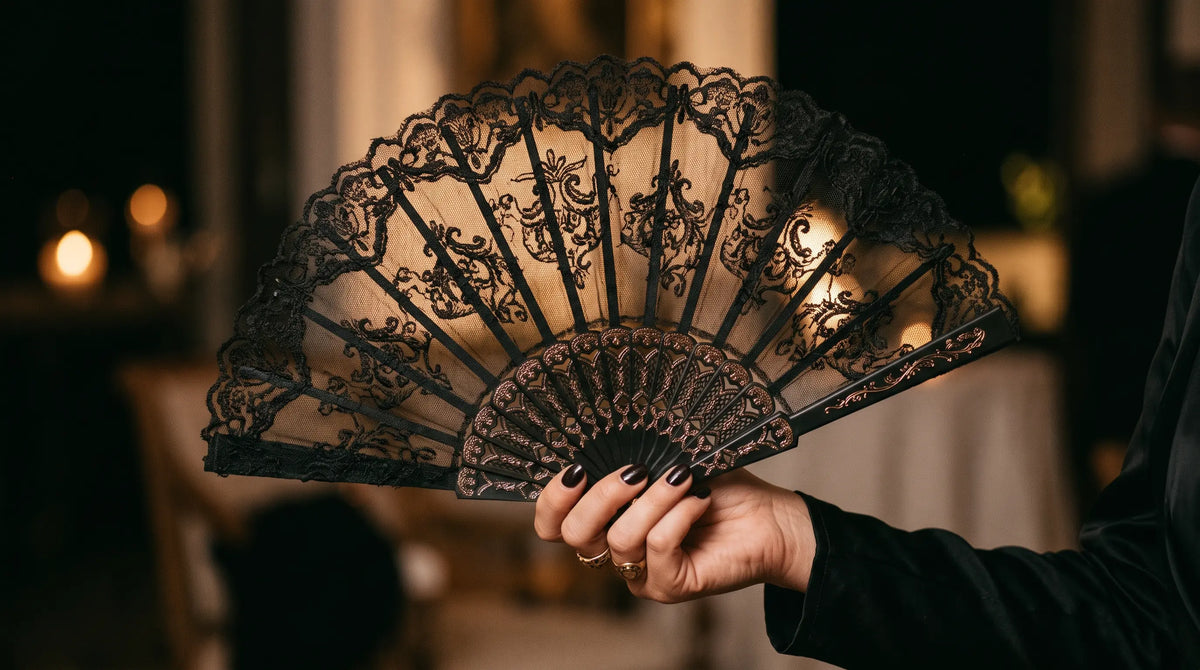
Decoration stability includes more than printed color. Some folding fans include lace, tassels, carved guards, sequins, embroidery, foil, or painted accents. Each decorative element adds beauty, but each one also creates a potential failure point. Testers check whether tassels are tied securely, lace is attached cleanly, and added details do not interfere with opening and closing. A decoration should enhance the fan, not make it fragile.
Color transfer is another concern. A bright or dark fan should not easily rub color onto skin, clothing, or nearby items. Testers may use a clean cloth to check whether pigment comes away during handling. They may also inspect whether colors bleed when exposed to moisture. While not every fan is designed for wet conditions, basic stability matters for confidence and comfort.
For customers, stable color means the fan continues to look intentional. It photographs better, feels cleaner, and can often be kept as a keepsake. This matters for brides, performers, collectors, and anyone buying fans as gifts. A durable fan holds onto its beauty, not just its structure. That is why color and decoration testing are part of the bigger durability story.
Final Quality Review Before a Fan Reaches the Customer
The final quality review brings all the testing together. At this stage, the fan is inspected as a complete product rather than a collection of separate parts. The tester opens it, closes it, holds it, looks at it from different angles, and checks whether it feels ready for real use. This step is important because a fan can pass individual checks and still feel slightly wrong as a finished item. The final review asks the most customer-focused question: would someone be happy to receive this?
A good final review includes appearance, movement, comfort, and consistency. The fan should look clean and attractive. It should open smoothly without catching. It should close neatly without forcing. It should feel comfortable in the hand, with no sharp points or rough edges. The decoration should be secure, the print should look intentional, and the frame should feel balanced. These qualities combine to create the full experience.
For bulk orders, the final review may also compare fans against one another. This matters when fans are used for events or resale. A single fan may look fine alone, but a group of fans should still feel visually consistent. Size, color, print placement, and folding behavior should not vary wildly. Customers ordering multiple fans want the set to feel coordinated and dependable.
This final step is also where care instructions can be confirmed. Even durable folding hand fans benefit from proper handling. Keeping them dry, closing them along their natural folds, storing them flat or in a sleeve, and avoiding crushing pressure can extend their life. Testing proves what the fan can handle, while care helps preserve it. When quality and care work together, customers get the best experience.
Conclusion
Folding hand fans are tested for durability through a mix of inspection, movement testing, stress checks, impact testing, environmental exposure, and surface review. Each test focuses on a different part of the fan, but the goal is always the same: to make sure the fan is attractive, functional, comfortable, and reliable. A durable fan should open with ease, close with grace, hold its shape, protect its design, and survive ordinary handling without falling apart. It should feel like a small object made with real thought.
The most important areas to test are the frame, ribs, pivot, rivet, leaf, folds, surface finish, and decorative details. These parts work together like a tiny orchestra. If one section is out of tune, the whole fan feels off. But when the materials are chosen well and the testing is done carefully, a folding hand fan can be both delicate-looking and dependable. That balance is what makes a great fan so satisfying to use.
For buyers, understanding durability testing makes shopping easier. You can look beyond color and pattern and start noticing the signs of quality: smooth movement, neat folds, firm pivot tension, clean attachment points, stable decoration, and comfortable handling. Whether you need a fan for everyday cooling, a wedding, a party, a performance, or a thoughtful gift, durability should be part of the decision.
Ready to find a fan that looks good and feels good in the hand? Browse the full collection at Get My Fan and choose a folding hand fan that fits your style, event, and everyday needs.
FAQs
1. How long should a folding hand fan last?
A folding hand fan can last a long time when it is made well and handled with care. Its lifespan depends on the materials, construction quality, frequency of use, and storage conditions. A fan used gently for special occasions may last for years, while a fan used daily outdoors will naturally experience more wear. To extend its life, close it along the original folds, keep it away from heavy moisture, and avoid crushing it inside bags.
2. What part of a folding fan breaks most often?
The most common weak points are the pivot, ribs, and fold lines of the fan leaf. The pivot handles repeated movement, so it can become loose if poorly made. Ribs may crack if the material is too brittle or too thin. The leaf can tear along fold lines if the paper or fabric is weak. Good durability testing focuses heavily on these areas.
3. Are bamboo folding fans durable?
Bamboo folding fans can be very durable when the bamboo is properly selected, cut, finished, and assembled. Bamboo is lightweight, flexible, and naturally attractive, which makes it popular for hand fan frames. However, quality still matters. Poorly finished bamboo can split or feel rough, while well-made bamboo ribs can provide a smooth and reliable fan experience.
4. Can folding hand fans handle humidity?
Some folding hand fans handle humidity better than others. Fabric fans and well-finished frames may be more forgiving, while delicate paper fans can be more sensitive to damp air. Humidity testing helps reveal whether the fan leaf wrinkles, the adhesive weakens, or the frame warps. Even with a durable fan, it is best to keep it dry whenever possible.
5. What should I look for when buying a durable folding hand fan?
Look for smooth opening and closing, even rib spacing, a firm but comfortable pivot, clean folds, secure leaf attachment, and a finish that does not rub off easily. The fan should feel balanced in your hand rather than flimsy or overly stiff. If you are buying online, choose a shop with clear product photos and a variety of options, such as Get My Fan

Share:
What AAA-Grade Bamboo Means in Hand Fans
Why Folding Fans Are Better Than Disposable Cooling Products